The Upper hand HOMO FABER
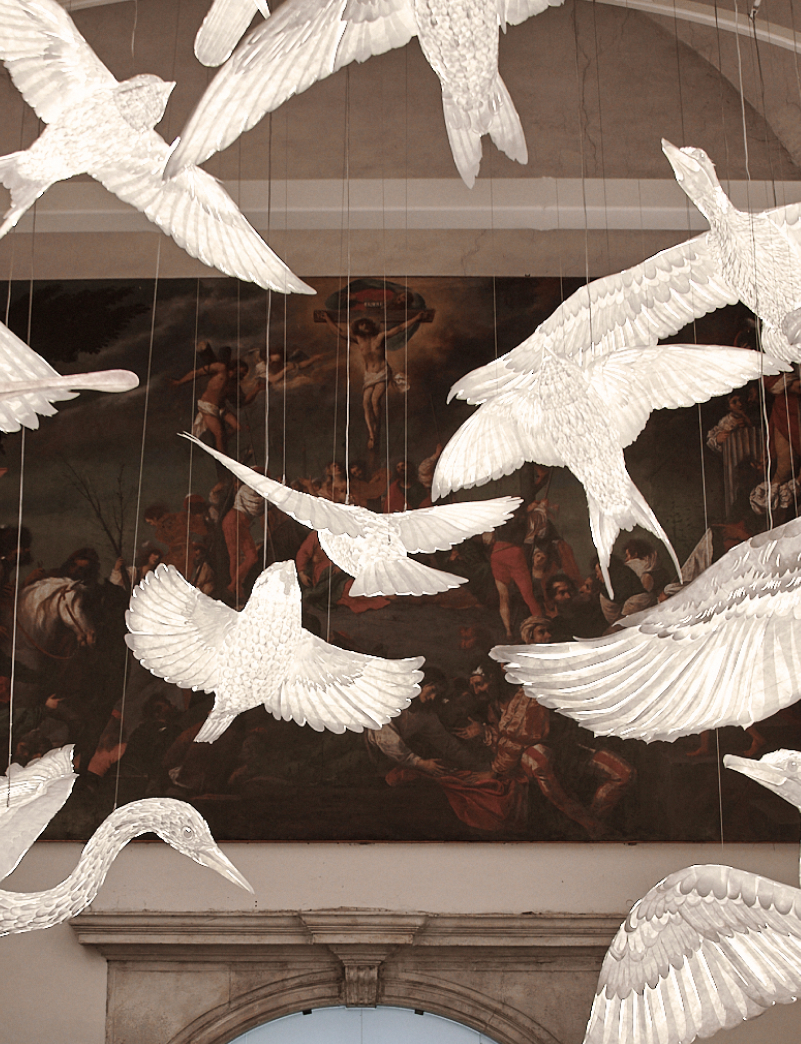
On San Giorgio Maggiore, the exhibition "Homo Faber" quietly crowns the world's finest hands — an unofficial World Cup of craftsmanship. Design would do well to take notes.
This is a story told in hands and hours. It follows fingertips tracing wood, stone, and metal; artisans weaving linen or shaping clay into vessels; it's a story of colour, pattern, tradition, and the workshops that hold them all together. The fourth edition of Homo Faber — the exhibition of human mastery staged by the Fondazione Cologni dei Mestieri d'Arte and the Michelangelo Foundation — brings together the best of international craftsmanship, while opening a window onto the techniques that shaped our world before industrialisation took over. Material once was precious and labour cheap; today, it's the other way around.
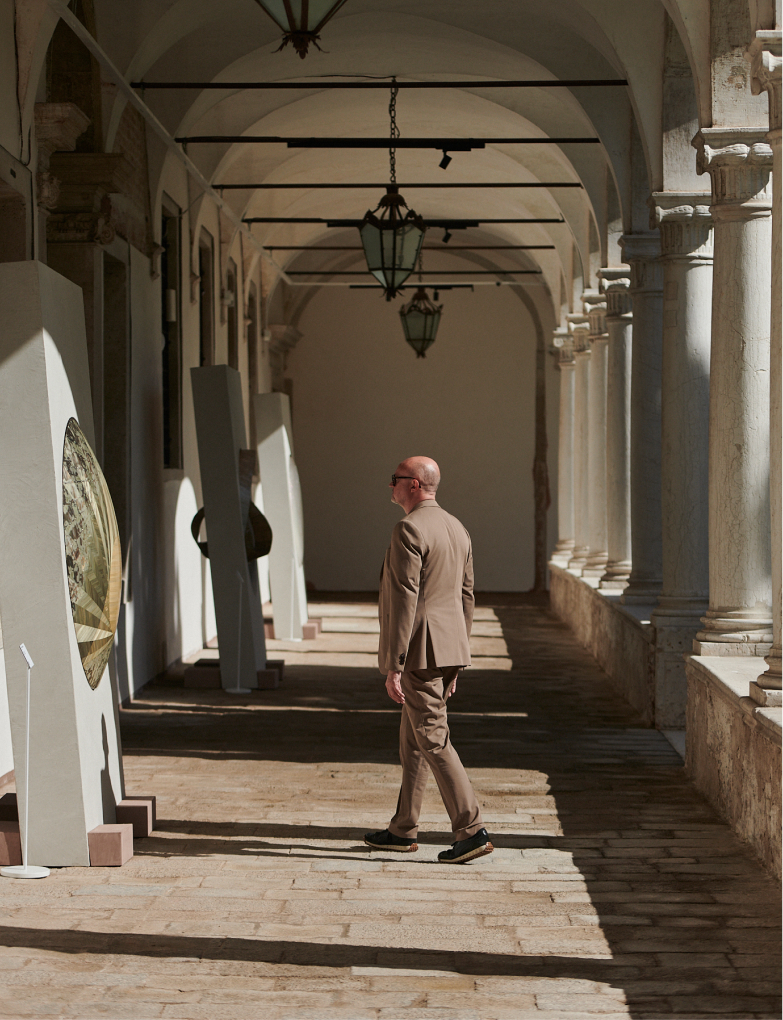
A bright summer morning arches over Venice, arguably continental Europe's most astonishing city. The boat glides past the Doge's Palace and crosses to the Isola di San Giorgio Maggiore. Monastery and church were designed by the Renaissance architect Andrea Palladio, with origins dating back to 982; at the last census, the island — barely a hectare in size — had a grand total of eleven residents: eleven monks. On this speck of land directly opposite Piazza San Marco, Homo Faber opens up a tour through artisanal traditions and techniques.
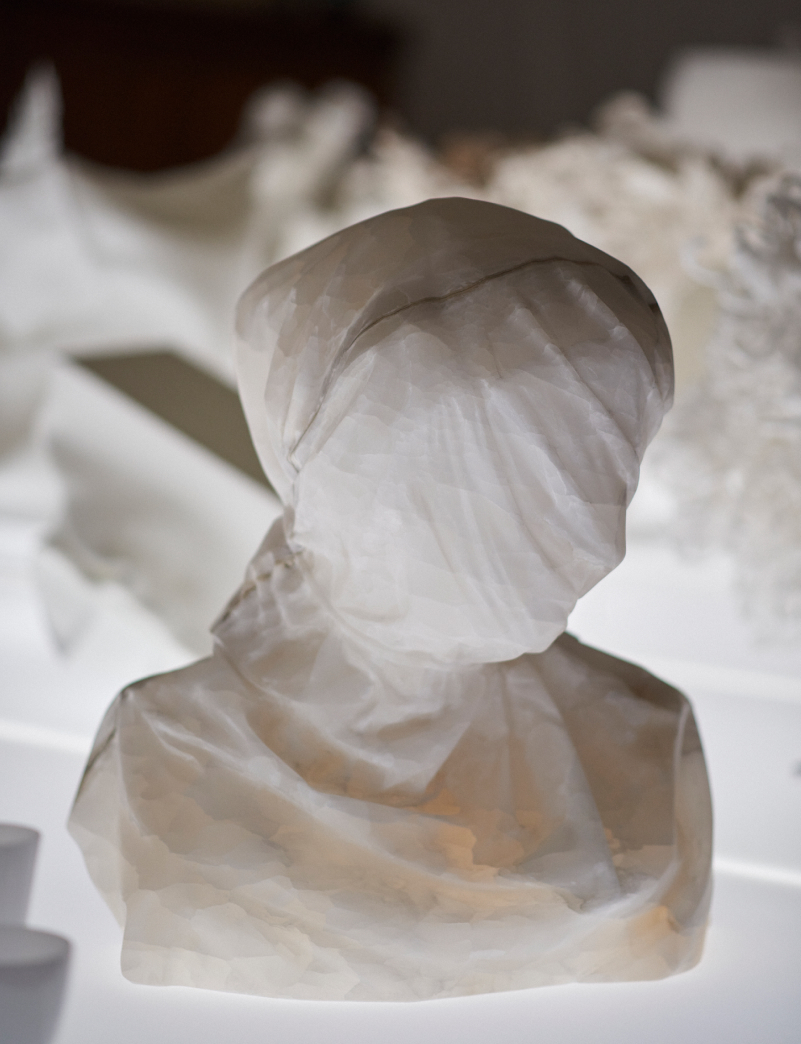
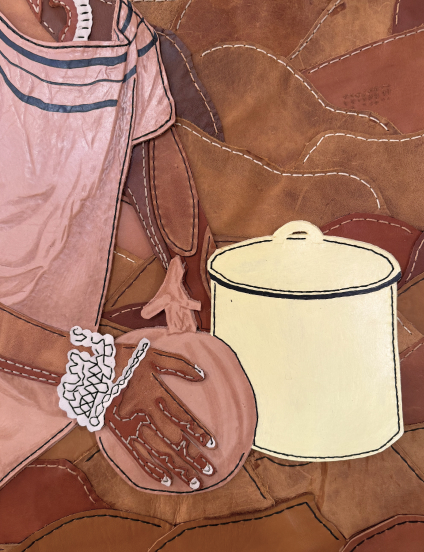
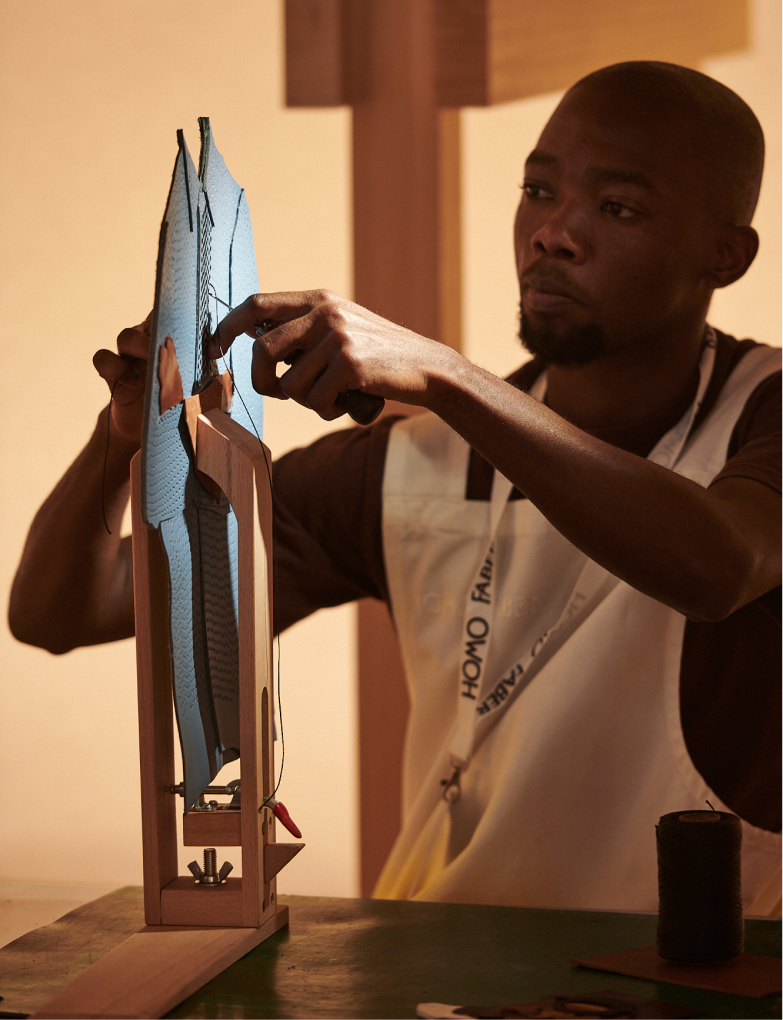
Abongile Sidzumo, a leather artist from South Africa, has set up a temporary workshop at one of the fifteen stations. The 30-year-old assembles leather with such artistry that it forms large-scale tableaux, giving age-old techniques a distinctly contemporary edge. He represents the skill of 400 practitioners from five continents exhibiting here — showing porcelain so delicate it masquerades as paper, woven furniture with the dynamism of a racetrack, and metalwork that appears somewhere between liquid and solid. What unites them all: they're testing exactly how far their material will go.
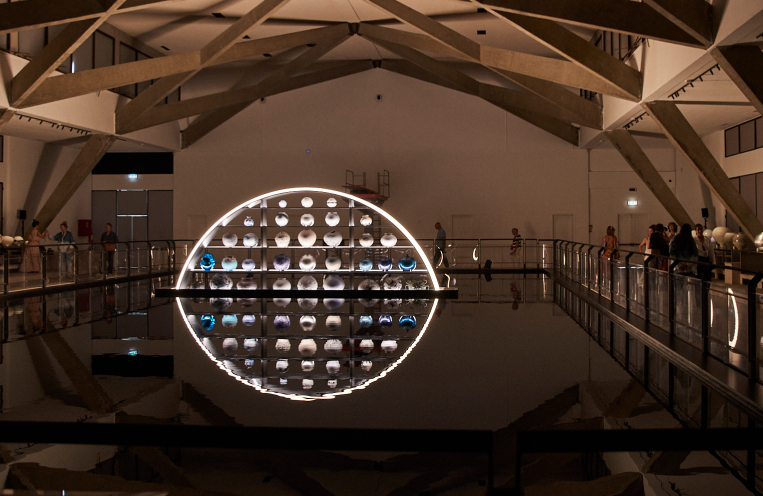
Catching Shadows
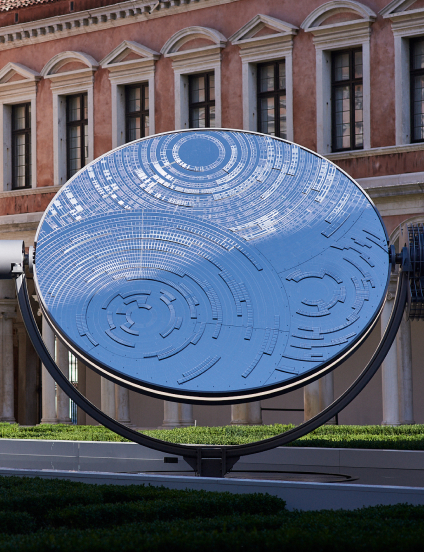
This fourth edition, staged by the Fondazione Cologni dei Mestieri d'Arte and the Michelangelo Foundation, was curated by the British designer Es Devlin. True to its theme, An Island of Light, objects here aren't locked away in glass cases — on the Isola di San Giorgio Maggiore, they're staged like artworks, wrapped in reflections from pools of water and mirrored halls. The route winds through the cloisters and gardens of the Fondazione Giorgio Cini. In Palladio's cloister, a kinetic mirror rotates on two axes above a shallow pool, while Gregorian chant echoes through the arcades. It's here that the exhibition tips towards pure spectacle — the theatricality of the staging arguably competing with the quiet force of the objects themselves. The path leads into a darkened hall, where selected pieces rotate on a turntable inside an enormous specimen case, lit by a single strong source at its centre. Shadows and outlines flicker across the walls. Plato's cave allegory, evidently, set in motion — save that no visitor is chained to the wall. Here, they become part of the staging themselves, free to examine the objects up close.
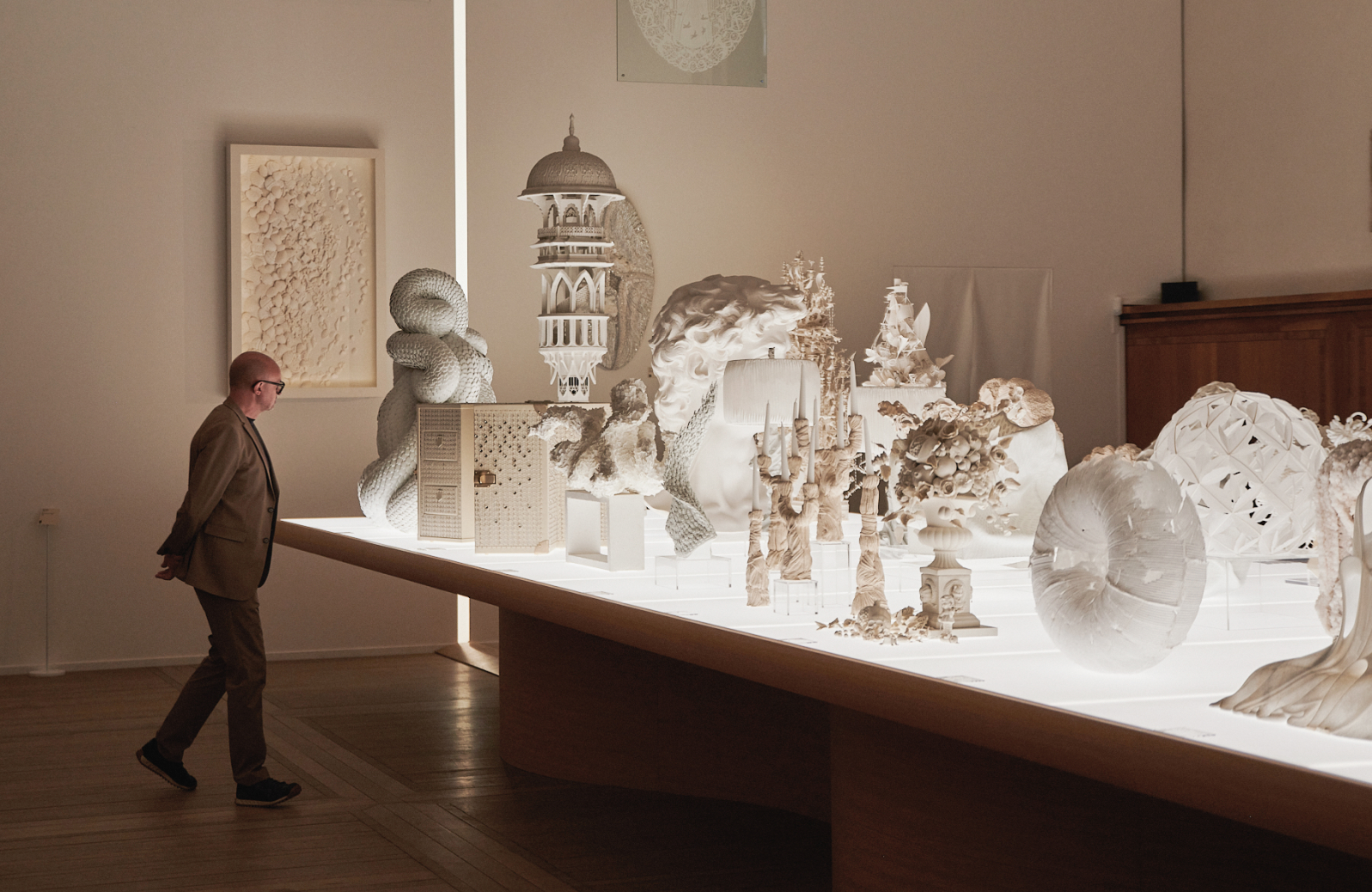
Between the installations, artisans are at work. They display masterpieces and explain, even to complete novices, arts such as kintsugi — the technique of restoring broken ceramics with gold lacquer so completely that the crack becomes part of the object's story, lending it extra character rather than diminishing it. The workshop run by Anita Cerrato and Chiara Lorenzetti lasts just over an hour. Aprons and gloves on, then it's down to tracing the repair lines with a fine brush and red bengara ursuhi iron-oxide lacquer, before the gold powder goes on. The scarred bowl then rests in a paper box and must be sprinkled with water daily. Full curing — after which the bowl can finally be used — takes up to twelve weeks.
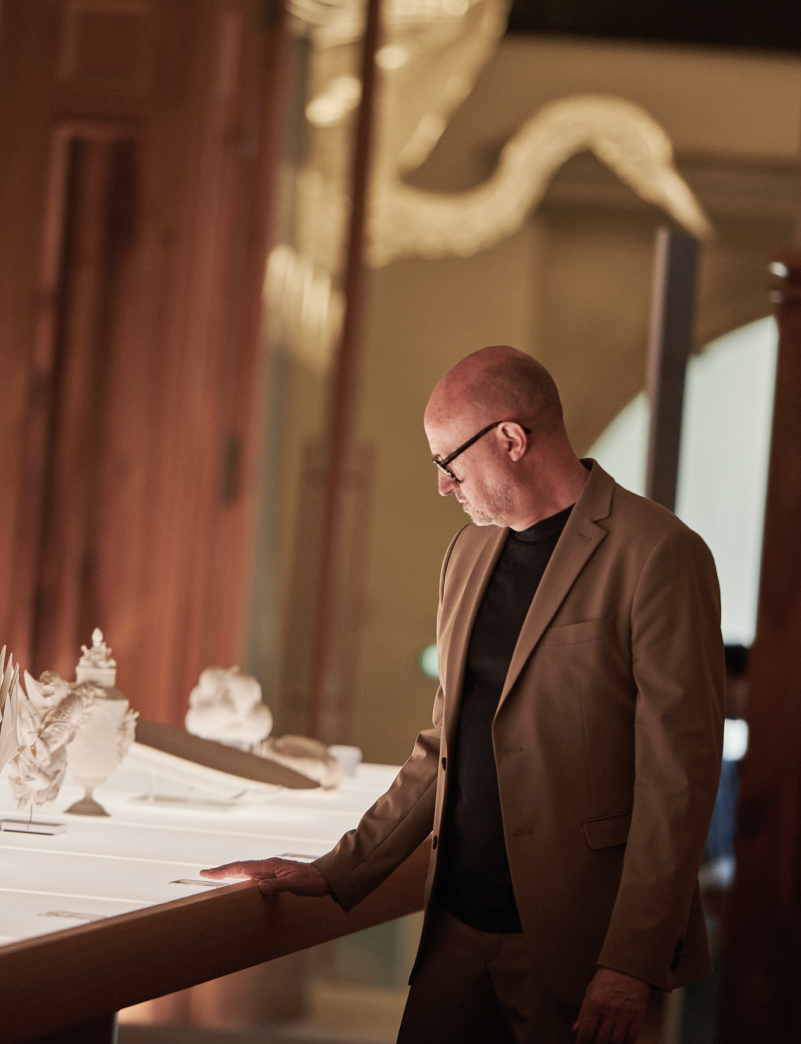
Good design must focus on the truly necessary elements and refine them as finely as possible.
Thinking with Your Hands
After a workshop like that, one's perspective shifts — whether the craft in question is hanko stamp-carving or origami. The material feels stubborn; working it takes practice. We evidently think with our hands, and need to "grasp" something to truly understand it. In 2017, the experimental psychologist Martin Grunwald caused a stir with his book Homo Hapticus. Grunwald argues nothing less than that every touch our body registers is processed biologically and psychologically, "without us necessarily becoming aware of it." Its subtitle amounts to a frontal assault on touchpads and sensory impoverishment: Why We Cannot Live Without a Sense of Touch.
If design today increasingly happens on a screen, without any direct contact with material, Homo Faber offers a counter-model. Wood, stone, paper, ceramic, glass, fabric and leather all resist being rushed, and this inertia of matter can only be overcome by investing time. Skill — mastery, even — arises precisely from that: at least 10,000 hours of practice and reflection on the things themselves. The French philosopher Henri Bergson considered tool use the defining trait of humankind, or close to it, coining the term Homo Faber. Today, AI is perhaps our most powerful tool yet. In the wrong hands, it leads to sensory and intellectual impoverishment; used well, it becomes a catalyst for our development. But that requires knowledge — or should we say mastery? In Venice, the exhibition of the same name illustrates just how much time and dedication good design demands, and how far an object's aura exceeds its material substance: some clay, paper or stone. In his 2008 book The Craftsman, Richard Sennett freed craftsmanship from the notion of mere skilled execution. By that logic, every artisan is someone who, over time, through attentiveness, engagement with material and tool, and the constant repetition of certain movements, sequences and patterns, grows ever more deeply bound to the task at hand — ultimately resolving it in flow, that pleasurable state of total absorption.
Whatever Happened to Quality?
This is where the connection to design gets interesting — design that, through increasingly sophisticated technical possibilities and production methods, risks losing direct contact with things themselves (system design being an obvious exception). The paradox is this: the easier it becomes to produce something, the harder it becomes to produce something distinctly one's own. The real paradox: this rather elegant observation comes courtesy of Claude, a reminder not to underestimate the personal signature that gets written into our work regardless. There's something restorative about watching a goldsmith at filigree work. Her craft cannot be sped up or scaled. The same holds for a carpet-knotter, a master veneerer, or a smith forging a fitting. In a world of flawless surfaces, irregularities have suddenly become the hallmark of quality and uniqueness.
Art, design and craft share more common ground than industrial production would suggest. When designers sit down to create today, the point isn't to pit AI against craftsmanship. Both must remain possible side by side, and ideally cross-pollinate. Craftmanship also preserves the exchange, the closeness, and the little imperfections that make us who we are. This isn't nostalgia, nor a bit of machine-sabotage in wooden clogs — it's a liberating insight: it is imperfection that defines us, and from it something truly extraordinary sometimes emerges: a vessel, a seal, or even a city like Venice.
The soul of things to come
Homo Faber and Mazda
Mazda first collaborated with Homo Faber in 2024. Since then, it has translated its Takumi approach — named after Japan’s highly skilled craftspeople — into a broader dialogue with artisans and audiences worldwide. In their own words: “Mazda and Homo Faber both celebrate the art of craftsmanship and the beauty of creating a craft that becomes one with its user.”
In 2026, the car company presents two participatory workshops: Kiintsugi, led by Italian artisans Anita Cerrato and Chiara Lorenzetti, and Hanko, led by woodcarvers Antonin Martineau and Nicolas de la Barre d'Erquelinnes. Both workshops draw inspiration from Japanese traditions, forming a bridge between Europe and Japan. They also connect craft and industrial design, specifically Mazda’s Kodo design concept, 'Soul of Motion', which is based on the idea that a car should convey energy and motion even when stationary. Head of Design Ikuo Maeda describes this approach as a search for essence. Jo Stenuit, Design Director at Mazda Europe, has expressed a similar view: good design, he argues, must focus on the truly necessary elements and refine them as finely as possible.